Artworks in Vantablack: void, emptiness and fertility
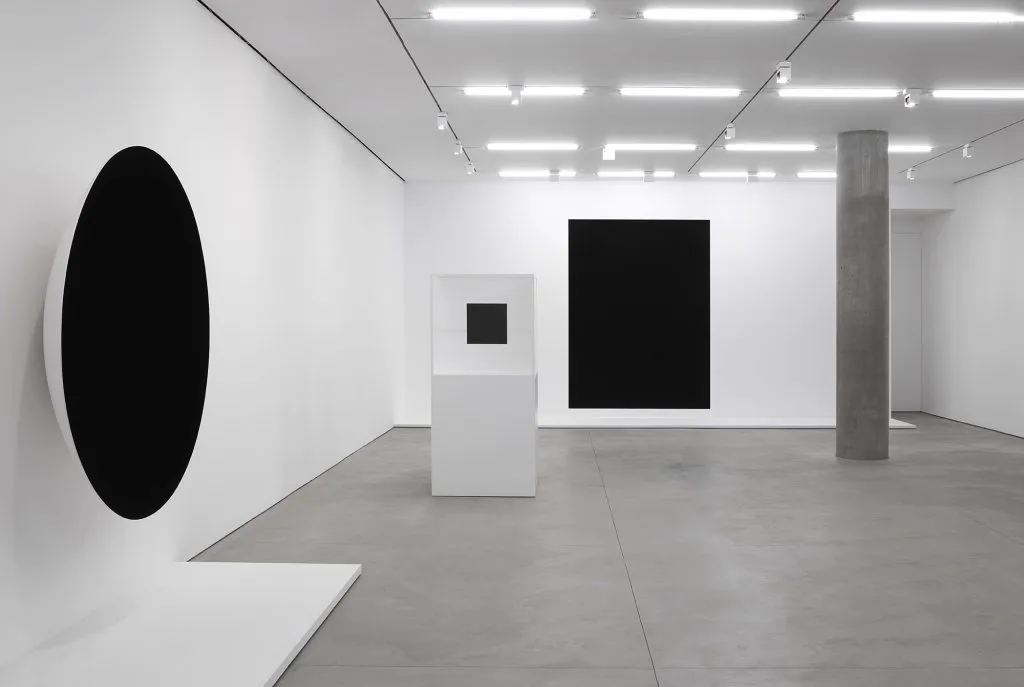
Exhibition of artwork by Anish Kapoor
Adventuring in territory of artistic creativity, I’ve recently seen an exhibition of work by Anish Kapoor at the Hayward Gallery in London.
Featuring works in mirrors (some exhibited outside), in Vantablack – the blackest known substance in the world – and visceral red (literally: evoking entrails and blood, they’re not easy viewing), the black captures my attention. Anish Kapoor holds the exclusive artistic license to use Vantablack, a super-black nanomaterial that absorbs over 99.96% of visible light.
Holes, hollows – and no perspective
The works that are simple shapes, on the walls and the floor – oval, circle, square and others – are deceptive. Utterly simple, these shapes are in Prussian blue (a very, very dark, very-nearly-black). They’re fascinating because they seem to be void, with no sense of depth or perspective. It turns out they’re actually holes or hollows – and the void is not nothingness: rather it’s a charged emptiness, reflecting what is unknowable. These works are rich, inviting and intriguing, both confronting and arresting, challenging my habitual and unconscious perceptions and interpretations, and inspiring in me both disorientation and awe.
Homi K Bhabha, Anne F. Rothenberg Professor of the Humanities at Harvard University (Anish Kapoor: Making Emptiness) notes that Kapoor’s view is that to see the void as a contained negative space indented in a material surface is only to engage with its physicality, whereas in reality one can find also something spiritual, profound.
The difference between void space and emptiness
‘To get to the heart of Kapoor’s thinking and making’, says Bhabha, ‘we must register the difference between physicality of void space, and truly made emptiness. Let us use Heidegger ‘s beautiful parable of the jug for these purposes……The potter, to make the jug a holding vessel, … has to shape the void. ‘From start to finish the potter takes hold of the impalpable void and brings it forth as the container in the shape of a containing vessel….. The vessel’s thingness does not lie at all in the material of which it consists, but in the void that it holds.’
It strikes me that the unknown that a new coaching client brings with them has much in common with Kapoor’s sense of the void.
Be with what is
Being present to the experiences inevitably and directly invites me to be with ‘what is’: I can’t impose or take for granted any of my own interpretations or assumptions. These works actually challenge our interaction with the world around us, and demand this kind of being present. I find it really refreshing – and it reminds me that when I’m with a coaching client, I can’t and mustn’t take anything for granted about them, their perspectives or their interpretations. I can’t and mustn’t assume that my interpretation of an observation, a question or a situation, and any meaning I might attach to them, are mine alone. My role is to invite my client to explore their meaning or interpretation: mine is actually irrelevant until and unless the client’s exploration might (but not necessarily) be usefully broadened by my sharing my perspective. Until then, the risk is that sharing my view closes down the client’s horizons.
Nothing to say
Anish Kapoor, as creator, innovator and artist, is famously reluctant to share any verbal interpretations of his work: he is quoted as saying ‘I have nothing to say as an artist’. This prompts me to question the extent to which I have nothing to say as a coach, and the extent to which any changes that the client makes are a result of the way I ‘be’ and ‘be with’ rather than anything I might do.
The Fertile Void
All of which brings to mind for me the Gestalt principle of the fertile void: John Leary-Joyce (author of ‘The Fertile Void: Gestalt Coaching at Work’ AoEC Press 2014) talks of the Fertile Void as ‘the paradox that someone or something could be simultaneously empty or full….. Trusting the process and staying with the void of the ‘not knowing’ allowed the space and time for something new and amazing to emerge’.
This notion feels to me directly pertinent to these extraordinary artworks, as they invite and enable us to remember that what may seem like a void, a silence in a conversation, a lack of data or a not-knowing, is not necessarily emptiness, but rather a place of rich, albeit undiscovered, fertility.
Photo courtesy of Lisson Gallery, New York. https://news.artnet.com/art-world/anish-kapoor-vantablack-2391684