opinion
We all take our families to work, in the shape of attitudes, beliefs, perceptions and themes in our lives. In my family, responsibility is a theme, and I’m interested to see how it shows up in our – and others’ – roles as leaders and team members.
One thing I notice is that imbalance in the way responsibility is used (and not used) in systems of all sorts, including organisations, is large-scale and widespread. It can lead to inertia – which reminds me of hedgehogs.
Too much responsibility assumed
Too much responsibility may be assumed (albeit unconsciously). This shows up with leaders who work hard to make sure that everything that needs doing is done, typically to a high standard, no matter whose responsibility it actually is. They may take on responsibility that belongs to those who report to them, who are their peers or who are their superiors because they judge that a task hasn’t been, or will not be, carried out to what they consider to be an appropriate standard.
They may be keeping an unconscious (or conscious) promise or a commitment they have made to a parent or another significant childhood figure to fulfil an aspiration that the parent themselves has not been able to fulfil, or an achievement they haven’t been able to attain. They may be – again unconsciously or consciously – trying to prove that they are good enough, worthwhile, or acceptable by doing the best job imaginable, even if that’s impossible. Those patterns, laid down in childhood, only shift when they’re noticed, questioned and examined.
Too much responsibility given
Inappropriate responsibility may be imposed in childhood, and taken on into work, via an expectation from one or other parent (e.g. ‘always look after your mother’ – and in the child’s interpretation, ‘always look after everybody else too’). Equally, that expectation may come from a boss who needs more in the role to be fulfilled than the role can actually accommodate, or from a promotion without anyone taking on the role that the individual has just left, so the privilege of promotion is diluted by also having to fulfil the previous role at the same time.
Blame for failure, explicit or insinuated, can also impose responsibility for a past error and its impact, how ever possible or not it is to adequately deal with that impact.
Too little responsibility assumed
When leaders fail to take on responsibility that is theirs, it may be that they feel inadequate to the task or it might be that cultural factors have conspired to persuade them that they don’t merit the role that they’re in. They may fear failing, and may persuade themselves that by not acting they don’t risk failure. Like the hedgehog who freezes in the middle of the road, they are likely to incur failure rather than avoid it.
Too little responsibility given
One of the classic situations in which appropriate responsibility is not given is represented by the micromanaging boss. In the process of over-attentive management or supervision, the individual being managed is disempowered, sometimes to the point where they feel unable, or too fearful, to take any action at all. This can lead to responsibility for decisions, initiative or innovation being shunted upwards, to the boss. In an organisational culture which tends to be punitive about mistakes or failures, that responsibility will be shunted even further upwards.
The impact of too much or too little responsibility
When an individual takes on too much responsibility, whatever the reason, that individual tends to lose sight of appropriate boundaries or choose unconsciously to ignore them. They may get exhausted, or at worst, burn out. They may lose the balance in their lives, their families, and their teams because everything is skewed towards the meeting of that responsibility.
When leaders take on too little responsibility we might see teams going adrift because they lack direction, agendas and strategies not being fulfilled, and difficulties and struggles in the team not being noticed or dealt with (which means they are simply perpetuated or even increased).
When an individual is deprived of appropriate responsibility, they may become detached or demotivated because they feel uninvolved and as though they don’t belong. That detachment means that team cohesion suffers and the team doesn’t pull together. They may not behave with integrity because they don’t feel entitled to stand up for what they believe is right.
Strikingly, in all these scenarios, both the team and the leader are weakened and become brittle: they lack resilience and the capacity to learn, develop and change as much as they could, and/or as much as they need to. Like the hedgehog, they may just get stuck in the middle of the road.
Appropriate responsibility
When appropriate responsibility is both given and taken, both leader and team are in balance, are able to fulfil their potential, and are supported on the road to flourishing and effectiveness. It’s a situation in which a systemic view (perhaps via systemic constellations, facilitated by a skilled practitioner), to illuminate dynamics which are otherwise hidden, can be an invaluable intervention.
Responsibility - and hedgehogs
Imbalance in the way responsibility is used (and not used) in systems of all sorts, including organisations, is large-scale and widespread. Too much responsibility may be assumed (albeit unconsciously). This shows up with leaders who work hard to make sure that everything that needs doing is done, typically to a high standard, no matter whose responsibility it actually is. Inappropriate responsibility may be imposed in childhood, and taken on into work, via an expectation from one or other parent. When leaders fail to take on responsibility that is theirs, it may be that they feel inadequate to the task or may fear failing, and may persuade themselves that by not acting they don’t risk failure. Like the hedgehog who freezes in the middle of the road, they are likely to incur failure rather than avoid it. One of the classic situations in which appropriate responsibility is not given is represented by the micromanaging boss. In all these scenarios, both the team and the leader are weakened and become brittle: they lack resilience and the capacity to learn, develop and change as much as they could, and/or as much as they need to.
Read more »
The Right Kind of Wrong
Amy Edmondson's new book 'Right Kind of Wrong: Why Learning to Fail Can Teach Us to Thrive' explains how we get failure (a potentially invaluable learning opportunity) wrong, and how to get it right, highlighting that the most successful organisational cultures are those in which you can fail openly, without your mistakes being held against you. We're living in turbulent times, and, as Amy Edmondson points out, failure is both more likely than ever – but if it’s the right kind of failure, it’s also more valuable than ever. While most failures in organisations are treated as blameworthy – and there are failures we should definitely work hard to prevent – there are others we should welcome. The latter are the intelligent failures.
Read more »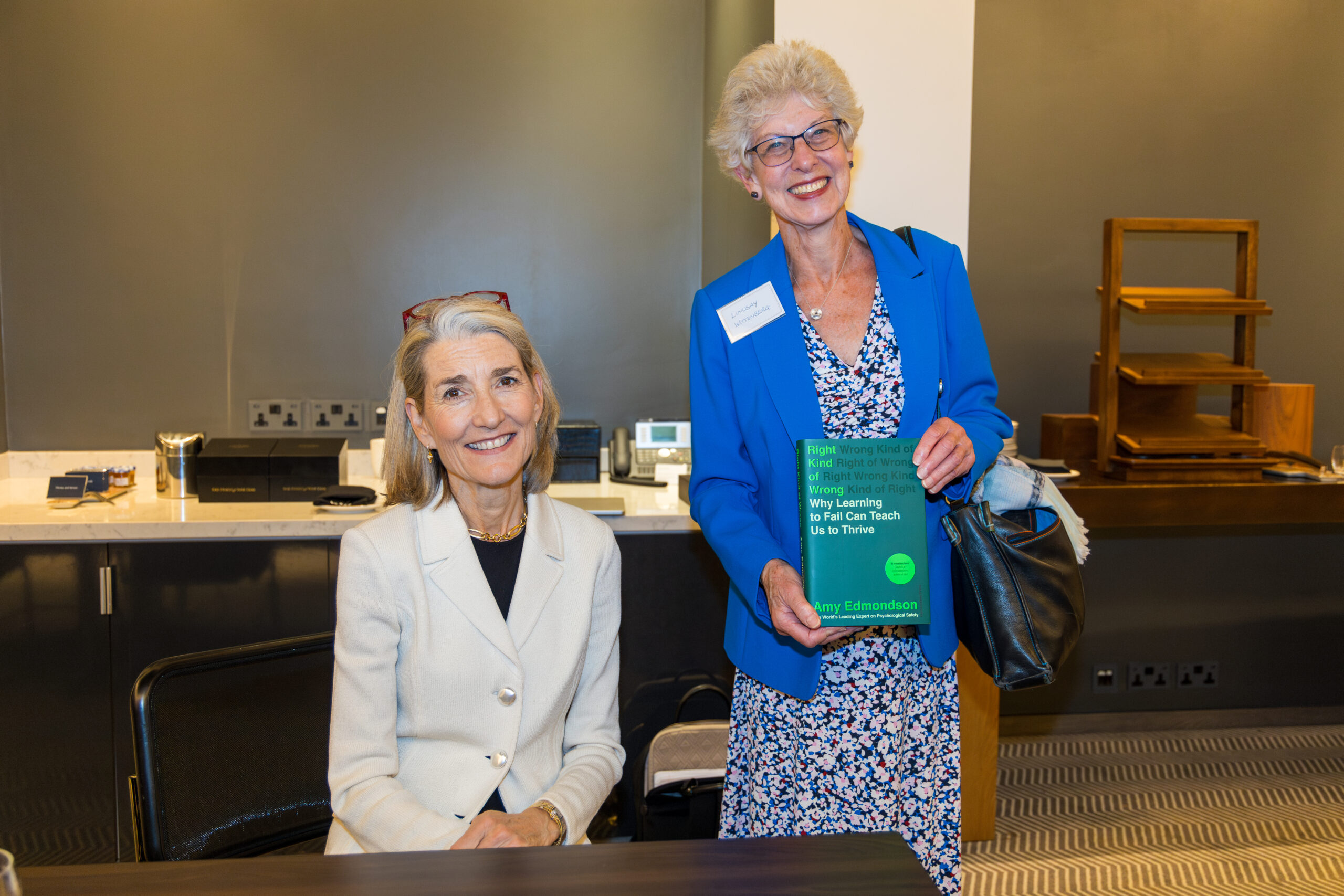
David Hockney, painting, and coaching
I recently had the opportunity to visit the stunning David Hockney exhibition in London (‘David Hockney: Bigger & Closer (not smaller & further away)’. It prompted reflection for me both on what it offers to my conceptualisation of coaching and what I can learn that might enhance my clients’ experience of coaching with me. I found the exhibition nourishing, exciting, inspiring, refreshing, perspective-opening and deeply calming. It stimulated my thinking on how I might raise my awareness and challenge myself to look in more depth, and call on more perspectives and insights, with clients. Is there any sense in which I currently satisfy myself with looking partially, on a relatively small scale, or only in one perspective? Besides widening our perspective, the artist also highlights the rewards of looking in every direction at the same time, all the time. He characterises water as illusive, because all the patterns you see are on the surface. If, as coach, I take those patterns as the only patterns, then I’m only seeing part of the person I’m working with, and only some of the influences they’re subject to.
Read more »
Who do you think you are?
I often hear leaders characterising themselves and their styles by reference to a set of behaviours, or a set of beliefs or values, or a combination of behaviours and beliefs. It's in this territory that the idealised self resides. The idealised self is the subject of quest, but probably not what is here now. And yet what is (and who is) now is, in a sense, the most powerful self we can be. However, I don’t often hear leaders describe their style by reference to their sense of who they are when they are truly present to themselves. Leaders I work with who discover and accept who they are tell me that the self- and system-awareness that is part of the discovery give them a palpable sense of acceptance, self-acceptance, peace and freedom. And from that emerge sustainable awareness of perspective, clear-sightedness about the ‘what’ and the ‘how’, compelling and engaging leadership, and capacity to relate healthily, learn and develop self, others and the organisation.
Read more »
Where am I going? Achievement, development and transformation
Objective-orientated - directional - coaching will be appropriate for certain clients with certain types of coaching need. However, such coaching isn’t developmental coaching, or indeed transformational coaching. Development and transformation tend to be emergent: just because a client doesn’t appear to be going somewhere doesn’t mean nothing is happening. On the contrary, a great deal might be happening. A lack of structure in the emergence shouldn’t be confused with a lack of something valuable. There’s another aspect too to this kind of emergent coaching: not just acceptance, but radical acceptance. This, in turn, relates both to radical inclusion and to ‘weak signals’. All are important underpinnings of outstanding leadership.
Read more »
Managing relationships: a somatic-relational lens
I’ve been working with a number of clients challenged by managing upwards or managing relationships with peers. In a variety of ways, I invited these clients to become aware of the bodily sensations and impulses towards movement that their individual experiences evoked for them. We worked together on the meaning of those sensations and impulses for them, and we worked at depth on any links with the various facets of how their ‘problematic’ relationships showed up in practice, with compassion and with a focus on the potential that new types of connection offered. Old messages and out-of-date interpretations came to the fore. Across these clients’ experiences there emerged an acceptance of ‘what is’, and an acceptance of ‘the other’ as they were rather than trying to fight it or resist it. They became more perceptive about the impact of ‘the other’ on them and theirs on ‘the other’. They felt more settled, safer, more trusting of themselves. They enacted more of their own true capability with a sense of greater space and freedom. Something important was released for them.
Read more »
Presence and positivity
Positivity of thinking, behaviour, communication, leadership, and the way we relate to each other as human beings brings benefits. And yet, positivity without a foundation of reality and connection with one’s audience isn’t useful at all, and can indeed be damaging. If I share a dilemma or a problem with another person, I feel unacknowledged, unheard and let down if their response is simply to invite me to look on the bright side, to look for the pluses, or to look for the solution – or even to give me what they think is the solution. Any positivity I might experience is then short-lived and insubstantial. I need the other person’s presence. I need to be seen, and then I can feel a connection. Without that connection the other person’s positivity is too superficial to make any kind of difference for me – and at worst can actually betray my trust. I also need the other person to be attuned with me – to be paying attention to my inner experience.
Read more »
Mirror, mirror
Following his arrival in a new role, a leader had been struggling with what he experienced as his line manager’s micromanagement and feeling like he had no voice. His line manager seemed to constantly present himself as being right, inviting no other views. The leader felt stifled and unheard. He felt isolated, and was beginning to get so disillusioned and distressed that he was wondering if the job was right for him. Things started to shift when he started to give attention in the coaching process to compassion for his line manager and the benefit of bringing more humility to the relationship. In a lightbulb moment he was shocked to realise that he, too, was behaving somewhat like his line manager in his interactions with his own team. His first step was to become more insightful and aware in the present moment. When we detach, we can more easily become aware of what might be reflected back to us from both others’ behaviour and our own. Might there be anything to learn from what we see in the mirror?
Read more »
Power and place – and invisible women
She was a senior manager in a male-dominated environment. Did she really need power in order to establish and maintain her position? Did she have power by virtue of her position, and if so, only because of her position? How did her power show up and how did she think it showed up? How can women reclaim their power in a balanced, proportionate, appropriate way when they feel it’s been misplaced between the genders? Factors that help include leaders who have humility, sensitivity and perceptiveness, and contexts of real psychological safety and openness to learning. This might well be the stuff of development once leaders have realised the central role of psychological safety in effectiveness, collaboration, teamwork, innovation and improvement. importantly, it’s worth remembering that power isn’t simply external, something that goes on between oneself and others. It’s also internal: a sense of power that we create inside ourselves, a message to ourselves about our place in the world and about our agency over our own lives, behaviours, and patterns of thinking and acting.
Read more »
The Art of Reflection - part 2
What is reflection? First of all, reflection after a coaching session, or after a learning experience between sessions, is space for enquiry, to build on the content of the coaching session or the experience, to surface more of what you're curious about and what you've learnt. And secondly, it’s time to be with yourself, just you and you, with the ease to allow thoughts and intuitions to surface – thoughts and intuitions that can hide when we’re caught up in the busyness and noise of doing, but which can be signposts to what doing, and what kind of doing, actually matter. Recall is supplemented by curious exploration and enquiry into why things happened the way they did: what were the messy bits, the puzzling bits, the successful bits? What behaviours, and on whose part? Very importantly, it’s a space where we can distil what we’ve actually learnt, what change we want to create from that learning, and what we become aware of that’s changed or changing. It’s a necessary complement to coaching sessions, which can only ever be part of the story, and not the whole story.
Read more »