blog
A sudden threat
It happened from one second to the next – no warning signs, no previous indications that anything was wrong. From simply feeling dizzy I found myself on the floor, having come round 15 minutes after losing consciousness. By amazing good fortune, I was discovered – which probably saved my life.
An emergency admission to hospital, and subsequent investigations, revealed internal bleeding, which was patched up while a decision was made about the best way forward. The date for surgery initially planned for two or three weeks away was brought nearer and nearer as the doctors became more and more concerned about the possibility of a recurrence and the potential negative consequences.
Surgery was carried out successfully, which saved my life for the second time – and, apart from now not having as much of my insides as I’d had previously, everything has been resolved and I’m back to good health.
I had rarely been ill in my life, my most serious complaint having been a bad cold.
Until the surgery had been completed and pronounced successful, and the biopsy showed there was no ongoing problem, the nature of what my life was to be was at the extreme end of uncertainty, with a possible threat to it.
Acceptance, resilience and presence
I’ve reflected at some length on how I travelled the journey from collapse through to recovery, and I see in retrospect that there are a number of key factors. Being present to my own experience without resisting it, and accepting both the experience and the situation on a moment-by-moment basis, have, I realise, been central.
I see that only by ‘being with’ what was happening could I have any of the awareness and freedom that offered me choice about how to respond to it. Strangely, I didn’t at any point feel frightened: maybe the acceptance took the fear away. I feel sure that my years of mindfulness practice accounted for my capacity to accept, and to face in to all the available facts and the possible outcomes.
I also felt (and still feel) immensely and genuinely grateful all the way through, and I imagine that will have influenced my state of mind too.
Just as significant in nourishing what some people referred to as my resilience were the most extraordinary and limitless support, caring and love from those close to me, my confidence in excellent, communicative and attentive medical care (thank you Royal Free Hospital and University College Hospital in London), and the kindness and care of countless friends, colleagues and family members.
A viral effect
During my hospital stay and afterwards I’ve been struck by how many people remarked on my effect on them, and what they referred to as my calm, my serenity and my positivity. Until then, I hadn’t quite realised the extent to which my demeanour impacted on the people taking care of me. My close family remarked on how easy I made it for them as we moved through the steps of tests, uncertainty, decisions, surgery, more uncertainty and its outcomes. Nursing staff said I inspired them through particularly tricky, unpredictable or critical moments. Porters said they wished they had my attitude to uncertainty and risk. And one of the surgeons who operated on me mentioned how rewarding the case had been for him.
These reactions have brought home forcibly to me the power of genuinely seeing the good in situations and constantly feeling grateful: it really is viral, and really does impact the way other people feel and what they see in their environments and those they work with and for. It was returned to me in the shape of warmth, caring and compassion, which will have contributed to my positivity of mind and body.
Learning for leaders
I’ve been reflecting too on lessons for leaders that might be inherent in this story. Heaven knows their working lives are filled with risk and uncertainty, in a context of high stakes.
Every action, every tone of voice, every conversation has an impact – and the impact of those actions, tones of voice and conversations will be rooted in the leader’s underlying values, beliefs, motivations and emotions, not simply from the words or actions themselves. These are what their people will experience, and what will carry them through situations that are uncertain or threatening.
The leader who’s present will be able to pick up trends, currents, and feelings around them – and will be able to tune in to their own authentic responses to people and situations, and thus manage those responses in full awareness.
The leader who accepts mindfully that things are as they are will be realistic and very likely have more insight than the leader who resists a situation they wish was otherwise. They’ll feel calmer too, and that will be viral.
The leader who’s appreciative, supportive and caring (and who encourages that sort of culture) will have a workforce with high levels of engagement, discretionary effort, effectivenes and customer satisfaction.
Leaders who have this level of self-awareness and systemic awareness, and the capacity for emotional self-management, will sow the seeds of building organisational health, flourishing and success in a climate of risk.
A journey through risk
An emergency admission to hospital..... Until the surgery had been completed and pronounced successful, and the biopsy showed there was no ongoing problem, the nature of what my life was to be was at the extreme end of uncertainty, with a possible threat to it. Being present to my own experience without resisting it, and accepting both the experience and the situation on a moment-by-moment basis, have, I realise, been central. I feel sure that my years of mindfulness practice accounted for my capacity to accept, and to face in to all the available facts and the possible outcomes. During my hospital stay and afterwards I’ve been struck by how many people remarked on my effect on them. For leaders every action, every tone of voice, every conversation has an impact. The leader who accepts mindfully that things are as they are will be realistic and very likely have more insight than the leader who resists a situation they wish was otherwise. They’ll feel calmer too, and that will be viral. The leader who’s appreciative, supportive and caring (and who encourages that sort of culture) will have a workforce with high levels of engagement, discretionary effort, effectivenes and customer satisfaction.
Read more »
Slowing down to speed up
A potential client, ‘a man in a hurry’, was looking for answers. Now. Another prospective client slowed down long enough to engage with the notion of the challenge – and the benefits – to him of that very slowing down, because he was interested in ‘exploring the hidden in order to grow’. The nature of organisational life frequently means that leaders are pressured to achieve clear, ‘correct’ outcomes – fast and with urgency. While this is standard, it militates against the possibility of achieving richer, wider, more sustainable outcomes because space hasn’t been made for reflection and for experimenting. A leader might consider becoming aware of when speed is the lived priority, and reflecting on the impact and outcomes of that priority. They might also consider putting in place processes, approaches and forums in which people can honestly express what’s going on for them, be truly heard without being offered opinions or judgments, and be acknowledged for who they are rather than what they do.
Read more »
The horse, leadership and me
I’m with a group of colleagues, learning about experiential leadership with executive coach and developer of leaders and teams, Jude Jennison, and her herd of horses. With a horse it’s critical to be in relationship (and useful to be able to identify how that manifests in your body), to be curious, to be present, to respect the horse’s freedom to choose and to offer clear direction. What won’t work is to be concerned about your competence or performance, because the horse will instantly pick up on your insecurity and will feel unsafe. And it’s hard to be in relationship when lack of safety is there. Jude’s insight about the importance of allowing the horse space and freedom so that together we can fulfil the task feels like an important illumination. We learn that the whole team needs to be in sync. Communication up and down the line is essential if the team is to stay cohesive. And the horse needs confidence in the clarity, intention, direction, energy and trust of both the leader and the whole team.
Read more »
What’s love got to do with it?
Client A is close to burnout. He constantly over-stretches himself to meet other people’s requests for help and for task fulfilment. As a child, he felt neither loved nor lovable: the only way he ever felt approved of or accepted was through his intellectual ability and achievements. Client B alienates others with her ‘honest’ but brutal and judgmental behaviour, has very high and unforgiving expectations of herself and of others, and is never satisfied with her own performance. These behaviours are getting seriously in the way of their leadership, and they both want to understand how to manage themselves differently. Besides the negative impact on their wellbeing, each is also damaging their career prospects. The coaching enquiry means they each experience a freedom in an awareness that gives them choices that they hadn’t offered themselves before. They learn, each in their own way, that there is strength and safety and a new-found sense of wellbeing in learning self-love, learning how to listen to their own needs, and self-acceptance. Love has everything to do with it.
Read more »
Endings and leavings
The primary emotions that arise from losing a sense of belonging need to be attended to, just as much as organisations need to acknowledge the contributions made by those who have left. Endings (and the associated feelings) that aren’t resolved or aren’t fully integrated into a system somehow ‘hang about’ and leave their impact to be felt, sometimes for decades, in the form of burdened roles. A particularly impactful ending is represented by death. There’s value in accepting ‘what is’, and being alert to what may be emerging: experiencing it as a state of being rather than thinking or doing. Loss or ending might actually be, above all, a fertile space – the Gestalt notion of the Fertile Void. Good endings allow for good beginnings.
Read more »
Are you being heard?
Voice matters because it is a channel for the self-expression that people need in order to feel acknowledged and seen, and – more broadly – because it can have a significant impact for a team or organisation when judgment, uncertainty, ideas and innovation, collaboration, communication and coordination are in the mix. An absence of voice may mean compliance or obedience, but it isn’t territory for sustainable engagement - and sustainable engagement is essential for the flexibility and adaptability that characterises resilient, robust, flourishing teams and organisations. What enables voice is psychological safety: believing that you won’t be punished or humiliated for speaking up with ideas, questions, concerns or mistakes. That belief means the leader, in the first instance, consistently modelling behaviours that authentically welcome inclusiveness and diversity (including diversity of thought), that mean that help is offered and requested freely, that engage without judgment in taking risks and failing, and that make open conversations the norm – all this without fear of judgment, penalty or exclusion.
Read more »
The illusion of solutions
Family therapist Barry Mason characterises solutions as ‘only dilemmas that are less of a dilemma than the dilemma one had’. There’s no such thing as right or wrong in the coaching encounter: no predetermined answers, no pre-set course, but rather flow and emergence, and the noticing of these. And here’s where certainty and uncertainty arise, mirroring the working environment - and particularly the leader’s environment. Thinking in terms of certainty may mean that the leader doesn’t see all the tripwires, since not everything is either certain or predictable. In my experience of coaching leaders, the capacity to allow, and allow for, uncertainty – frustrating as that may be – also allows for versatility, responsiveness to the situation as it is, rather than as one wants it or assumes it to be, and creativity. Which in turn allows for a more agile response.
Read more »
Coaching through COVID and Beyond
Are you an NHS/care sector worker struggling to manage stress, get your mojo back or work out next steps? If so, we can help! Coaching through Covid and Beyond offers FREE confidential independent support to key workers who wouldn't normally have access to high-quality coaching. Maybe you just want a one-off chat, or you'd like to sign up to a programme of up to six sessions - whatever works best for you. You can get in touch via our website www.coachingthroughcovid.org or email us at info@coachingthroughcovid.org and we can take it from there.
Read more »
Award for Coaching through COVID and Beyond
Pro bono coaching programme Coaching through COVID and Beyond (of which I'm a co-founder and a member of the core team) has won the Coaching at Work magazine award of External Coaching Champion (Organisation). The depth of our psychological safety in the core team has meant that we’ve been able to have difficult conversations in a spirit of openness and honesty, we’ve been ready to take risks in a context of uncertainty, we’ve been agile and responsive and happy to experiment in a spirit of ‘test and learn’, and we’ve welcomed diversity of all kinds. Living diversity means that we’ve constantly called on our collective intelligence - and so we've been able to achieve innovative success in several important ways.
Read more »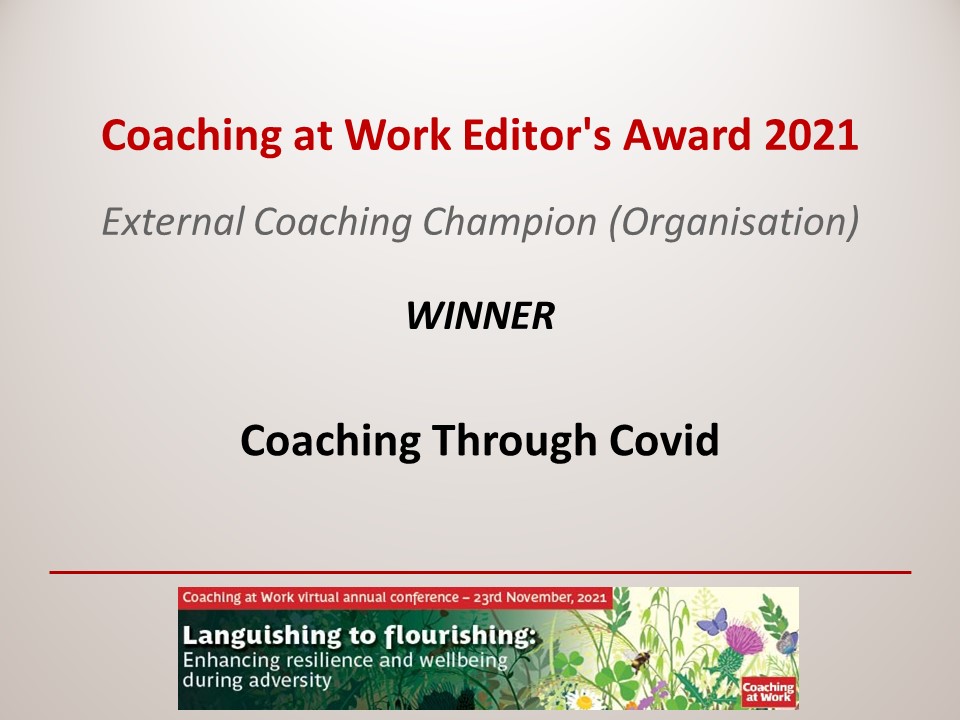
Trauma
Trauma is a living expression of a life-changing experience that often can’t be expressed in words but is a fundamental – and literally visceral – part of an individual’s identity. The range of manifestations is endless, including addictions, anxieties, physical pain, illness, problems with sleep, problems with relationships, and repeating patterns of behaviour which are counter-productive but which the individual doesn’t seem able to change. Despite appearances, the most apparently well-balanced, cheerful and obliging colleague may be hiding pain and distress which can get triggered and thus result in unexpectedly negative behaviour. The need for compassion and self-compassion, patience and acceptance, curiosity and tolerance is significant. What do you notice at work – about yourself and others?
Read more »